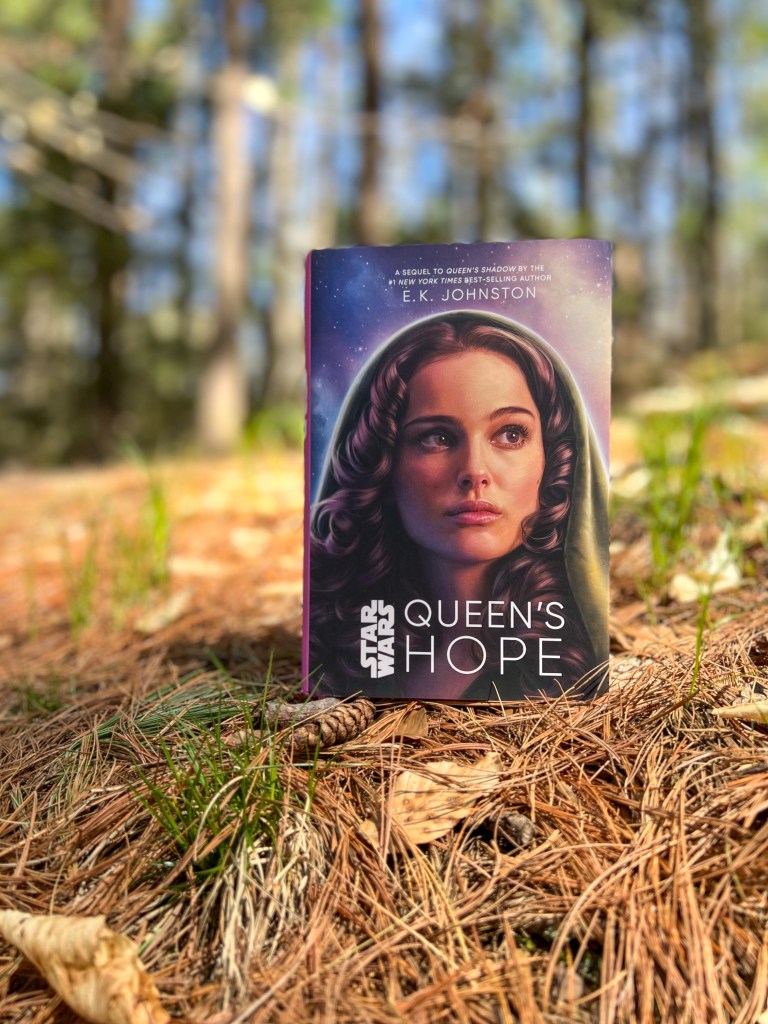
Meanwhile, with Padmé on a secret mission, her handmaiden Sabé steps into the role of Senator Amidala, something no handmaiden has done for an extended period of time. While in the Senate, Sabé is equally horrified by the machinations that happen there. She comes face to face with a gut-wrenching decision as she realizes that she cannot fight a war this way, not even for Padmé.
This feels like such a cool moment in time if you’re a Star Wars fan who loves the prequels & The Clone Wars. With Mike Chen’s BROTHERHOOD, the Obi-Wan Kenobi show, and Kiersten White’s PADAWAN on the way, there’s just some phenomenal prequel-era storytelling happening.
And of course, the finale to E. K. Johnston’s trilogy about Padmé and her handmaidens (the trilogy is called THE QUEEN’S HANDS by the author, so I’ve stuck with that for the blog).
QUEEN’S HOPE takes place at the very beginning of The Clone Wars, which means the book does feel like something of a companion novel to the aforementioned BROTHERHOOD.
This is a quiet, understated book. All three books in this trilogy have been thoughtful & almost entirely character driven, with nary a space battle across the whole trilogy. But Johnston has created something really special with these books & I’m so glad to have read them!
It’s really hard not to notice the way that these books, QUEEN’S HOPE in particular, are as much about Sabé as they are about Padmé. Sabé has created a really rewarding life for herself on Tatooine, but her devotion to Padmé brings her back into the the world of politics on Coruscant, and once again assuming the role of Amidala.
The story feels like a coda to Sabé’s story in some ways, although I understand she does make some appearances in the Darth Vader comics which is…fascinating.
There’s a really great standout scene between Sabé and Anakin Skywalker in QUEEN’S HOPE, one that kind of teeters right on the edge of silliness and…something that hints quite a bit at the darkness in Anakin.
This one also features some really cool “behind the scenes” moments surrounding Anakin & Padmé’s wedding, which of course takes on a very bittersweet flavor.
Johnston continues to write these books with a lot of great queer representation & inclusivity. While I had hoped she would feature more prominently in the story, we do meet Sister, a transgender clone trooper. It really is more of a walk-on appearance, rather than a true part in the book. It was really cool to see her introduction to Anakin, though, and hopefully we’ll see more of her in other stories.
We also get the trilogy’s first nonbinary character in Tepoh, a meticulously organized aide to Saché. There’s some new handmaidens in the mix, but it’s Tepoh we see the most from. Tepoh’s pronouns are zhe/zher, and zhe is a really cool addition to the cast of characters.
Gah. I’ve really loved these books so much. I definitely think they are somewhat niche, but anyone looking to take a closer look at the relationships between Padmé and her handmaidens (particularly Sabé) is going to find a lot to dig into with this trilogy.
The books are introspective & gentle & so completely unique when held up against so many of the other canon Star Wars novels. Sad to see this trilogy end, and I really hope to see more of these characters (and more Star Wars books by E. K. Johnston) in the future!
May the Force be with you!
 Grimdark Dad